
Faster cycles with fewer steps
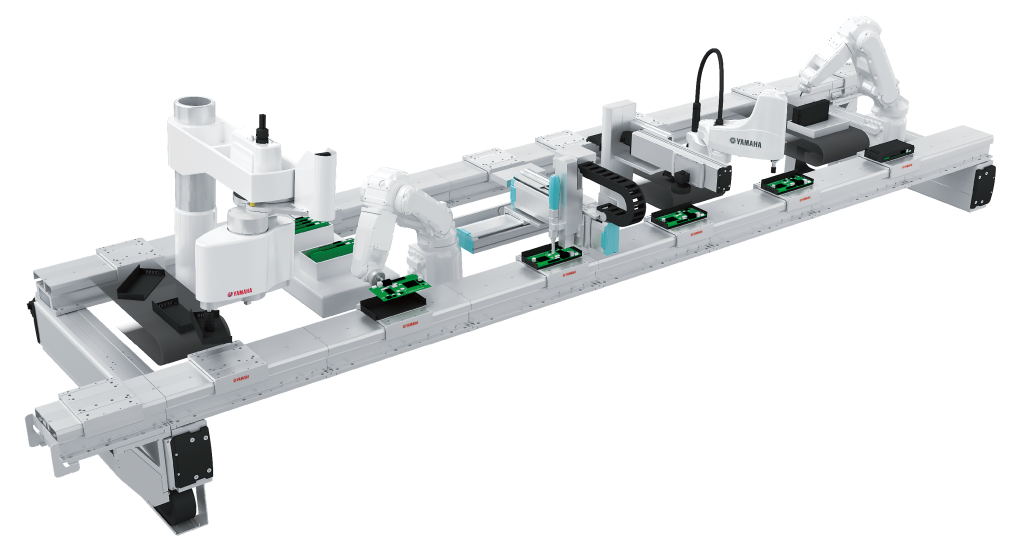
A conventional conveyor cannot stop a workpiece accurately on its own. It decelerates, meets a mechanical stopper, and the workpiece is lifted off the line to a work bench before being returned. The LCMR200 removes those steps. Each slider is driven by a linear motor and positions itself directly, so the work can be carried out on the slider without transferring the workpiece anywhere.
Built-in driver and simplified wiring
Each LCMR200 module has its own motor driver built into the frame. There is no separate driver to mount in the control cabinet, and the modules are connected to the YHX controller through a single YQLink cable. Adding a module to the line means adding one cable, not a new set of components.

Fieldbus integration with your existing PLC
The YHX controller connects to the host PLC over the fieldbus your line already uses. EtherCAT, PROFINET and EtherNet/IP are supported for up to 64 axes, and CC-Link for up to 22. The same controller also drives YAMAHA single-axis and SCARA robots, so transport and handling can be operated from one system.
Circulation units for continuous slider return
On a closed line, sliders have to return to the start. YAMAHA supplies two standard circulation units: the JGX16-H moves a slider sideways onto a return line running parallel to the working line, and the JGX16-V moves it onto a return line underneath, which saves floor space. Both are aligned at the factory, so on site the unit is mounted against the end plate and taught. A linear scale at the transfer section corrects the positioning, which keeps the accuracy stable as the ball screw expands with heat.

The circulation pitch is fixed when the unit is ordered — 200 to 1,350 mm for horizontal circulation and 300 to 600 mm for vertical, in 50 mm steps — and cannot be changed on site afterwards. Reversing the cable extraction direction on the forward and return modules brings the horizontal pitch down to 200 mm, which shortens both the return travel and the space it takes.
Traversing units for branching and retracting
When one process takes longer than the rest, it sets the pace for the whole line. The JGX16-T traversing unit moves a slider sideways onto a second row, so that process can run on two stations in parallel while the rest of the line keeps its rhythm. Branching is available in two-row and three-row versions.
The same unit can also pull a slider out of the line instead of branching it. A workpiece can be taken off for a sampling inspection, or a part that failed inspection can be moved to a rework station and put back into the line at the same point, without stopping production.
Faster start-up with the YHX standard profile
The YHX controller comes with a standard profile: a set of ready-made commands that the host PLC calls over the fieldbus. Motion for each slider does not have to be written from scratch, so most of the work at start-up is configuration rather than new motion logic.
- Sliders are moved by direct value commands or point-to-point moves, without writing motion logic for each one.
- Points can be added and adjusted with a handheld pendant.
- Servo can be switched on for a single slider independently of the rest.
- Alarm information is passed through to the host PLC.
- The line is operated from the host PLC’s own ladder program, so the existing control concept stays in place.
Most of the commissioning effort therefore goes into layout and process, not into writing motion code.
Where the LCMR200 is used
The LCMR200 suits lines where small parts are assembled and inspected in sequence, and where the layout is likely to change.
Automotive components
Housings, connectors and sensor units assembled and inspected in sequence.
Battery cells and modules
Stacking, welding and inspection steps that need to run at a fixed pitch.
Electronics assembly
Small, light parts with tight positioning tolerances.
Medical devices
Traceable assembly where each unit follows the same route.
Lines running several product variants are a second case. Because each slider is addressed individually, sliders carrying different variants can travel at different speeds and stop at different stations on the same line, without mechanical changeover.
LCMR200 Technical Specification
| Max. speed | 2,500 mm/sec |
| Max. payload | 30 kg (horizontal) / 5 kg (vertical) |
| Repeatability | ±0.005 mm (single slider) |
| Max. acceleration | 1.3 G (at 1 kg dynamic load) |
| Module lengths | 200 / 300 / 500 / 1,000 mm |
| Max. total stroke | 25.5 m (depending on system configuration) |
| Max. number of sliders | 64 (depending on system configuration) |
| Frame cross-section | W175 × H109 mm (including slider) |
| Controller | YHX (separate power supply required) |
| Field networks | EtherCAT, PROFINET, EtherNet/IP (up to 64 axes) CC-Link (up to 22 axes) |
Frequently asked questions
How long can a line be?
Up to 25.5 m of total stroke and up to 64 sliders, depending on the system configuration. Modules of 200, 300, 500 and 1,000 mm are combined to reach the length you need.
Does it work with our existing PLC?
Yes. The YHX controller connects over EtherCAT, PROFINET or EtherNet/IP for up to 64 axes, and CC-Link for up to 22. The line is operated from the host PLC.
Do the sliders need to return to a home position after a power cut?
No. Position is held by a magnetic absolute sensor, so the system knows where every slider is when it powers up.
How accurately does a slider stop?
±0.005 mm repeatability for a single slider. Between sliders, the mechanical tolerance is ±30 µm, measured at the dowel holes.
Can the line be extended later?
Modules can be added to change the transfer length. Circulation pitch, however, is fixed when the circulation unit is ordered and cannot be changed on site, so it is worth deciding that at the design stage.
Can it be used in a clean environment?
The transfer section is covered by a top enclosure, which YAMAHA designed to keep objects dropped during line set-up out of the internal mechanism. For requirements in controlled environments, please contact us and we will clarify the specification with the manufacturer.
Availability and support in Europe
Seika Sangyo GmbH supplies YAMAHA linear conveyor modules from Düsseldorf. We handle quotations, technical questions during the design phase, commissioning support and spare parts for customers across Germany, Switzerland and the wider European market.
Line design is where most of the decisions are made: circulation pitch, module lengths, the number of sliders and how the YHX controller fits into your existing control concept. These are easier to settle before the order than after it, so we are happy to look at your layout early. Send us a sketch or a description of the process and we will come back with a configuration and a quotation.